Big three astrology: Sun, Moon and rising sign read together
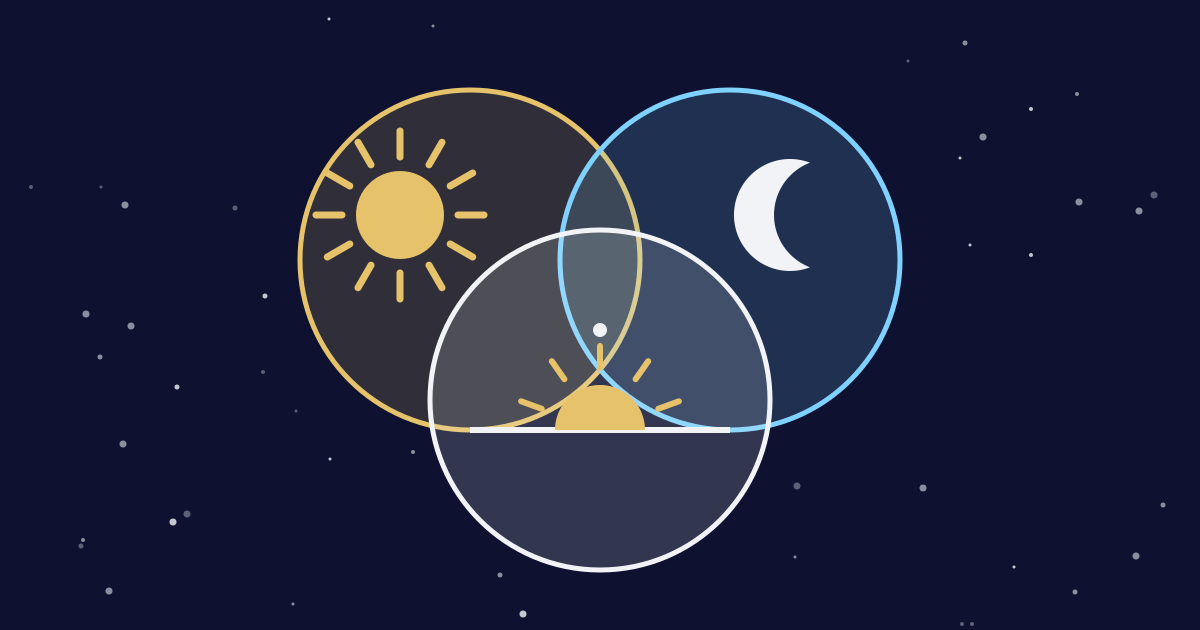
Big three astrology starts from a familiar puzzle: a friend tells you she is a Cancer, then adds that she is blunt, quick to anger and has no interest in staying home. Either astrology is wrong about her or the Sun sign was never the whole story. The usual answer is to read the Sun, the Moon and the rising sign together, because each one speaks for a different layer of a person.
Big three astrology: what each of the three adds
The Sun, the Moon and the Ascendant change sign at very different speeds: the Sun once a month, the Moon every 2.3 days or so, the Ascendant about every two hours. Together they separate you from almost everyone else born in the same week.
- Sun sign: what you aim at, your sense of purpose and the role you grow into.
- Moon sign: what you need in order to feel at ease and how you react before you think (see moon sign meaning).
- Rising sign: the manner you meet new situations with, and the first impression you give.
Traditional astrology never used the Big Three as a package; it is a modern shorthand, and a useful one for beginners. Treat it as the skeleton of a reading, not the reading.
One date, five different Big Threes
To see how much the clock matters, enter this example in the birth chart calculator: New York, 15 Jul 1990, on summer time. Same day, same place, five birth times:
| Local time | Sun | Moon | Rising |
|---|---|---|---|
| 02:00 | Cancer | Aries | Taurus (29°17') |
| 08:00 | Cancer | Aries | Leo (19°51') |
| 14:30 | Cancer | Aries | Scorpio (6°56') |
| 20:00 | Cancer | Taurus | Capricorn (17°26') |
| 22:00 | Cancer | Taurus | Aquarius (26°07') |
The Sun stays in Cancer all day. The Moon changed sign at 19:29. The rising sign has gone through five different signs. So a Cancer Sun is a very thin description, and the rising sign is the part that varies most between people who share a birthday.
How to read the three together
- One plain line each. "Aims at ...", "needs ...", "meets the world as ...". Avoid adjectives that could fit anyone.
- Compare elements and modes. Fire, earth, air and water; cardinal (starts), fixed (holds), mutable (adapts). Two of three sharing an element is the chart's main colour.
- Measure the Sun to Moon distance in signs. It says how well your aims and your needs speak the same language (table below).
- Find the loudest voice. The one of the three that sits close to an angle, makes the tightest aspects, or is ruled by the chart ruler (the planet ruling your rising sign).
- Write a two-sentence portrait and test it against what you know of the person.
| Signs apart | Relation | What it tends to feel like |
|---|---|---|
| 0 (same sign) | Conjunction | Aims and needs agree, little inner debate, can feel one-note |
| 2 | Sextile | Friendly elements, easy to cooperate with yourself |
| 3 | Square | Same mode, different element: friction that drives action |
| 4 | Trine | Same element, smooth, sometimes complacent |
| 6 | Opposition | Born near the full Moon: swings between two poles |
| 1 or 5 | No major aspect | Different element and mode: two languages, a lot of translation |
Count in signs, then check the exact angle in the Aspects tab: two signs apart can still be far from an exact sextile if one planet is early in its sign and the other late.
Worked example: Cancer, Aries, Scorpio
The 14:30 chart: Sun 23°00' Cancer in the 9th house, Moon 27°04' Aries in the 6th, Scorpio rising at 6°56'. Step by step:
- Plain lines: aims at security and belonging, needs action and quick resolution, meets the world guarded and watchful.
- Elements: water, fire, water. Modes: cardinal, cardinal, fixed. The water is what other people see; the fire is hidden.
- Sun to Moon: three signs apart, a square. The tight aspect list shows it at an orb of 4°03'.
- Loudest voice: Scorpio rising points to Mars (and, in the modern scheme, Pluto) as chart ruler. Mars is at 2°07' Taurus in the 6th house, so the chart's engine runs through daily work and routine.
My two-sentence reading: someone who feels deeply and keeps it to themselves, yet whose private reactions are quick and impatient; protective of people and a little restless inside. That portrait is a hypothesis, not a verdict. You test it, and the rest of the chart (the other planets, the houses, the aspects) refines it, as the step-by-step reading order shows.
Three patterns worth knowing
Once you have the three signs written down, look at how they sit together. There are only a few shapes, and each reads differently.
- Two of the same element. The most common shape. That element becomes the chart's main colour, and the odd one out is the part of you that surprises people.
- All three in one element. Rare and very consistent, say Sun, Moon and rising all in earth. People with it often say they feel understood by their sign, and the risk is a blind spot for everything the element lacks.
- Three different elements. The shape of the example above has two water signs and one fire, but plenty of charts have fire, earth and water or air. Here the work is to find what links the layers, and the chart ruler is the first place I look.
The same logic applies to modes. Three cardinal signs start many things and finish few; three fixed signs hold on; three mutable signs adapt. The Analysis tab of the calculator counts all ten planets by element and mode, which tells you whether the Big Three is typical of the whole chart or only of its surface.
When the three disagree
They usually do, and I distrust charts where they all line up too neatly. The rule of thumb I give students in big three astrology: people who live with you notice the Moon, people who meet you at work notice the rising sign, and your own sense of direction is the Sun. When a friend says "that does not sound like me", ask which setting they were describing.
The common mistakes are reading each placement from a sign list in isolation, and trusting a rising sign from a rounded or guessed time. The rising sign changes about every two hours and is the part you are least likely to be able to check; the guide on rising sign and birth time shows what to do when the record is vague. With no time at all you still have the Sun, and the Moon on most days, which is two of the three.
Frequently asked
What is the Big Three in astrology?
Your Sun sign, Moon sign and rising sign (Ascendant). Tradition gives them three jobs: the Sun shows what you aim at, the Moon what you need in order to feel at ease, and the rising sign how you meet the world and how others first see you.
Which of the Big Three matters most?
None outranks the others. People who know you well tend to recognise the Moon, strangers meet the rising sign, and the Sun describes what you are working towards. Read them together and add the chart ruler.
How do I find my Big Three?
Enter date, time and place of birth in the birth chart calculator. The Big Three card shows Sun, Moon and rising sign with degrees. The rising sign needs a birth time; Sun and Moon usually do not.
What if my Sun, Moon and rising sign are all different elements?
That is the usual case and it is not a problem. It means the three describe different layers of you. Look for the planet that links them, often the chart ruler, instead of trying to average them.